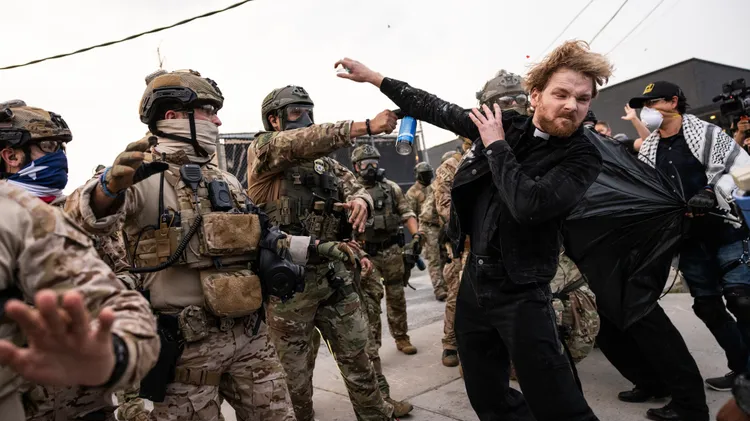
The visual is stark. A young man clad in a simple black suit, leans away from a stream of fluid spraying into his face from the canister in his antagonist’s outstretched hand. His head and body turn so violently that his hair is briefly suspended in midair, captured in the photo preserving this moment at an anti-ICE protest in Chicago. The canister of pepper spray is held by an armed ICE agent. The suited young man wears a clerical collar, a public declaration that this protester is an ordained minister.
What is the impact of images of peacefully protesting identifiable clergy being violently opposed, beaten, or arrested by armed forces? One could argue that these images poke holes in the arguments that the Trump administration is one motivated by Christian Nationalism, but such arguments would fail to understand the simultaneous complexities and reductivism of Christian Nationalism, where multiple self-contradictory views are held while Christianity is narrowly and exclusively constructed.
Days later, a similar scene, this time with an ordained woman at its centre. The visual impact of videos of a woman in her clerical collar being violently dragged from a stationary line of protesters, thrown to the ground, and forcibly handcuffed, of a minister pinned to the asphalt by the neck, of a clergyman pepper sprayed while he stands motionless, praying, or of that first young minister being shot in the head with a pepper ball from a rooftop is undeniably unexpected, and at first glance, contradictory to the stream of Christian Nationalist rhetoric we have seen and heard from the MAGA establishment and its devotées. If the USA is “a Christian nation” as so many have said, why are they targeting not only clergy but also identifiably Christian clergy?
There is no ‘out’ for the insiders who refuse to play by the rules of white supremacy. In the moments before her death, Renee Good was not being a “good Christian woman” as far as Christian Nationalists are concerned: she was queer, she was defiant, and she was standing with the marginalized and targeted. In doing so, as @professionalyapper19 argues, Good distanced herself from her own whiteness, from the privileges of white supremacy. By being aware of and rejecting her own racial privilege to ignore the violence of white supremacy, and motivated by her own faith, she refused to sit idly in that privilege. She chose a side, and it was not that of white supremacy.
The clergy who protest are similarly situated, drawing a hard line between themselves and a bigoted establishment. In doing so, they are not “good” Christians; their Christianity is apostasy in the eyes of Christian Nationalists, even when their particular denomination is historically conservative. What the proponents of the “Christian nation” argument fail to identify – whether intentionally or merely due to incuriosity – is that there are, functionally, many Christianities, not only in America but throughout history and today across the globe. The Christianity that is promoted by Christian Nationalists is particular: it is white; it is socially conservative and conforms to “traditional” gender-norms; it is exclusivist and xenophobic; and it is deferential to establishment power. In practice, it is violent, unkind, unmerciful, and unkind. By Christian Nationalist standards, I am not a Christian. Despite this, I refuse – and argue, as others have – that they are; though I have no doubt whatsoever that their Christianity is misguided, cruel, and actively rejects the most fundamental tenets of our faith, I still claim them, and in so doing, own them as a problem that we, as a church, made and that we must therefore solve.